Essex County Clerk of Court NJ manages official court records and delivers key clerk services for the county’s judicial system. The office records filings, certifies legal documents, and maintains public records within the county court administrative office structure. Based in Newark, the clerk supports daily courthouse operations and keeps records organized for civil and county matters. This office plays a central role in Newark NJ courthouse services by preserving legal documents with accuracy. It supports the broader New Jersey trial court system through structured recordkeeping and document control. Clear documentation helps courts operate efficiently and protects the rights of residents and legal professionals.
The Essex County Clerk of Court NJ serves attorneys, residents, business owners, and researchers who need verified legal documents. The office handles court filings, certified copies of deeds and mortgages, trade name registrations, and election-related records. Through its clerk services, the office maintains transparency within the judiciary structure and supports public record availability. Attorneys rely on timely filing stamps, residents request property records, and businesses register official documents. By managing these clerk office responsibilities NJ courts depend on, the office strengthens trust in the county court system and keeps official records secure and accessible.
Current Essex County Clerk & Responsibilities
Essex County Clerk of Court NJ is currently Christopher J. Durkin, a long-serving elected official who continues to lead the county’s clerk services as of 2026. Durkin won re-election in 2025 and began his fifth five-year term, reflecting strong voter support for his work in Essex County court leadership. Christopher J. Durkin brings decades of public service to the office. He was first elected Essex County Clerk in 2005 and took office in January 2006. Before that, he led Human Resources for Essex County and served as a detective with the Essex County Sheriff’s Office. Durkin holds a degree in Political Science from Rutgers University and a master’s degree in Human Resources from Seton Hall University. His background includes work in education, county administration, and party leadership.
Key NJ Clerk of Court Responsibilities
The Essex County Clerk of Court NJ manages a wide range of statutory duties that support court operations and public record systems. The office functions as the administrative backbone for document control, record preservation, and certified filings. Each department within the clerk’s office follows structured procedures set by New Jersey law. Clear organization improves efficiency and reduces delays for residents and attorneys. These responsibilities form the foundation of NJ clerk of court responsibilities statewide.
Primary Duties Include:
- Overseeing Court Filings & Public Records: Records civil filings, property documents, election materials, and trade names while maintaining secure archives.
- Managing Office Staff & Departments: Supervises divisions handling civil, criminal, and probate-related records.
- Ensuring Compliance with NJ Regulations: Maintains strict adherence to state statutes governing court documentation and public record retention.
- Implementing Digital Filing Systems: Expands electronic filing and online document request options to improve processing times.
Impact on Residents and Legal Professionals
Effective leadership within the Essex County Clerk’s office directly affects daily courthouse operations. Attorneys depend on accurate filings and certified copies for active cases. Residents rely on property deeds, notary services, and official certificates for legal and financial matters. Digital initiatives reduce wait times and improve record retrieval. Through structured court administration Essex County, the clerk’s office supports transparency, accountability, and public confidence in local government records.
How to File Court Documents in Essex County
Document filing Essex County involves a clear set of steps that help residents and legal professionals submit court paperwork correctly. Whether filing civil, criminal, or probate documents, following the right process ensures filings are accepted without delays. You will also need to understand court filing fees NJ, formatting requirements, and filing options before submitting any document. This guide breaks down each stage of the filing process and highlights common pitfalls to avoid. It also includes practical advice for electronic and paper submissions, so you feel confident with your next court filing.
Process for Court Filings
Before starting the filing process, it is important to understand which court division your case belongs to and what type of documents are required. Each division — civil, criminal, or probate — has specific rules, forms, and procedures. Proper preparation ensures that your submission meets the NJ court document submission standards and avoids unnecessary delays. Planning ahead also helps you calculate court filing fees NJ and organize your supporting materials for smoother processing.
Determine Your Case Type
Start by identifying the type of court document you must file. Essex County accepts filings for several categories:
- Civil Cases – complaints, motions, responses
- Criminal Matters – indictments, motions, release documents
- Probate & Estate – wills, letters of administration, accountings
Obtain the Correct Forms
Visit the clerk’s office or official court website to get the correct forms. Many forms are available online for NJ court document submission and can be printed or filled electronically. Make sure you use the most current version of each form.
Prepare Your Documents
Before filing, arrange your paperwork in this order:
- Cover sheet or case information sheet
- Main document (complaint, motion, petition, etc.)
- Supporting exhibits or attachments
- Proposed order (if required)
Use standard 8½” x 11” paper and type your text clearly. Handwritten forms are usually not accepted unless specific instructions say otherwise.
Check Court Filing Fees NJ
Most filings require a fee. Fee amounts vary based on case type. For example:
- Civil complaints often carry a base fee
- Motions may have separate charges
- Probate filings can differ depending on complexity
Filing Requirements: Paper vs. Electronic
Paper Filing
Paper filing is the traditional method of submitting legal documents in physical form to a court or government office. It involves manually preparing, printing, and delivering documents for official record-keeping and processing.
To file in person:
- Take your completed documents to the clerk’s office
- Present copies for the court’s records
- Pay the required filing fee (cash, check, or card may be accepted)
- Receive a stamped copy for your records
Electronic Filing (eFileNJ)
NJ courts use efile NJ courts for many case types. Electronic filing lets you submit documents online without visiting the clerk’s office.
Benefits of electronic filing:
- Faster submission and timestamping
- Automatic notices to parties
- Easy access to filed documents later
To file electronically:
- Register with the eFile system used by New Jersey courts
- Upload each document as a PDF
- Pay fees online
- Receive confirmations by email
Formatting and Submission
Proper formatting helps avoid rejections. Here are best practices:
- Use a readable font such as Times New Roman or Arial (size 12)
- Leave standard margins (usually 1 inch on all sides)
- Include a case caption with court name, parties, and docket number
- Ensure signatures are clear and include dates
- Attach exhibits in order with tabs or clear labels
Common Mistakes to Avoid
Many filings are returned or delayed due to simple errors. Being aware of these common mistakes can save time and frustration. Most errors relate to missing fees, outdated forms, incorrect captions, or illegible submissions. Addressing these issues before filing increases the likelihood your documents are accepted on the first attempt. Taking a moment to double-check your paperwork helps ensure compliance with court paperwork Essex County standards.
Avoid these frequent errors:
- Missing Fees: Submitting documents without the correct payment will delay filing.
- Wrong Form Versions: Using outdated forms often leads to rejection.
- Illegible Documents: Blurry scans or unclear handwriting may not be accepted.
- Incorrect Captioning: Every document must clearly show the case title and court.
- Unnecessary Pages: Only include what is required; extra pages slow down review.
Accessing Public Records in Essex County
Accessing public filings and record certification in Essex County lets you find civil, criminal, probate, and land records that are open to the public. Many Essex County court records and official documents are searchable online, while others require an in‑person visit or formal request. Below is a complete step‑by‑step user guide to help you perform an Essex County document search and get certified copies when needed.
Official Search Tools & What They Do
Here are the official tools you will use to find public records:
- NJ Courts Public Case Search URL: https://www.njcourts.gov/ht/search
This is the official New Jersey Judiciary public access search portal where you can look up civil and criminal case information statewide, including Essex County court dockets and filings. - Essex County Public Records Electronic Search System (PRESS): https://press.essexregister.com/prodpress/index.aspx
This tool is hosted by the Essex County Register of Deeds and Mortgages and lets you search property records (deeds, liens, mortgages) dating back to 2001 and older indexed records. - Superior Court Clerk’s Office Records Request
This is used when the records you want are not available online. You download or complete request forms and submit them for certified or plain copies.
How to Search Public Court Records Online
- Open your web browser and visit https://www.njcourts.gov/ht/search.
- Select the type of record you want to find:
- Civil case records
- Criminal case records
- Judgment liens
- Enter search criteria such as party name, docket number, or case type.
- Click “Search” and review the list of results.
How to Search Essex County Property Records (Land Records)
Enter https://press.essexregister.com/prodpress/index.aspx in your browser.
This is the official public records search system for Essex County land transactions.
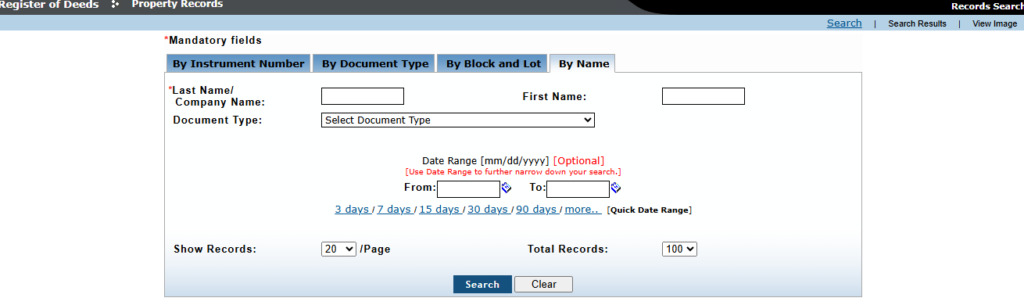
Use the Search Fields
In the PRESS system:
- Enter the name of the property owner you are searching for.
- Use date range filters if you know when the transaction occurred.
- Choose the document type (e.g., deed, mortgage, lien).
- Click the search button.
Review Results
PRESS returns a list of matching records. You can view index information showing book/page or instrument number. Note that very old images might not be online, and you may have to request them in person.
In‑Person Public Record Search
If a document is not available online:
- Visit the appropriate office in Newark.
- Superior Court Clerk’s Office for civil, criminal and probate records.
- Essex County Register of Deeds and Mortgages for land records.
- Go during regular business hours (typically Mon–Fri, mid‑morning to late afternoon).
- Use public computer terminals to search indexes or ask staff to show you how to use offline records.
- Note down the docket number or recording information you find.
Requesting Certified Copies or Record Certification
If you need an official or certified copy of a document:
- Check whether the record is available online or in person.
- Download or complete the record request form from the Superior Court Clerk’s Office.
- Submit the form electronically via the Judiciary’s document system or in person at the courthouse.
- Pay applicable certification fees (fees vary by record type — for example, certified copies and seals may have separate charges).
Restrictions on Public Records
Not all court records are available to everyone. Some records are restricted by law or court rule. Examples include:
- Sealed or expunged criminal records (e.g., juvenile cases).
- Confidential materials or medical reports used in court decisions.
- Records protected by statute from public disclosure.
Court Filing Fees in NJ
Court filing fees NJ represent the charges required to submit documents to New Jersey courts. Knowing the costs beforehand helps residents, attorneys, and businesses prepare properly and avoid delays in civil, criminal, probate, or appeal cases. These fees support court administration, recordkeeping, and public access to legal documents. Essex County follows the standardized filing fee schedule NJ with some exemptions for low-income residents.
Types of Court Filing Fees
Before listing the fee types, it’s important to understand that each category of filing has different rules and fees. Filing costs vary based on the case type, complexity, and whether additional motions or documents are involved. This ensures that the court can cover administrative expenses and provide efficient service while maintaining fair access for the public.
- Civil Case Fees: Applied for complaints, motions, or civil judgments. Fees depend on the case type, such as general civil, small claims, or special proceedings. Certain motions or amendments may incur additional charges.
- Criminal Case Fees: Covers filing motions, appeals, and transcript requests. Fees differ between municipal and Superior Court levels.
- Probate & Estate Fees: Charged for filing wills, letters of administration, estate accountings, and guardianship documents in the surrogate court. Larger or more complex estates may carry higher fees.
- Appeals Fees: Required for notices of appeal, appellate docketing, and transcript requests, depending on the court and case complexity.
Fee Waivers and Eligibility
Low-income residents may qualify for fee waivers, allowing them to file without paying the full cost. To apply, individuals must provide proof of income, public assistance, or other financial hardship. Fee waiver forms are available at the Essex County Clerk of Court NJ office or via the New Jersey Judiciary online portal. Waivers are common in civil, family, and certain probate cases, ensuring access to justice regardless of financial situation.
How to Pay Court Filing Fees
Online Payment
- Visit the New Jersey Judiciary court payments portal.
- Select your case type and enter the required case or document details.
- Use the portal’s interactive system to calculate total court filing fees NJ.
- Pay via credit/debit card or e-check.
- Save the confirmation receipt for your records.
In-Person Payment
- Go to the Essex County Clerk of Court NJ office or Superior Court filing counter.
- Submit completed documents and indicate your payment method (cash, check, or card).
- Receive a stamped copy confirming payment.
Record Certification & Copies
Record certification ensures that a court document is recognized as an official, authenticated copy of the original. This service is essential for legal, financial, and administrative purposes, providing proof that a document is genuine. In Essex County, residents, attorneys, and researchers can request certified court documents to verify court filings, probate records, or property-related documentation. Before diving into specific procedures, it’s important to note that certified copies carry an official seal or stamp from the clerk’s office, confirming their authenticity. They are widely accepted in other courts, banks, government agencies, or for personal records. Fees and processing times vary depending on the type of record and the method of request.
How to Request Certified Copies
Requesting Essex County clerk certified copies can be done in multiple ways: in-person, by mail, or online, depending on the document type. Typical steps include:
- Identify the Document: Determine the type of record needed—civil, criminal, probate, or land-related filings. Having the docket number or case details speeds up the process.
- Choose a Request Method: Decide whether you will visit the clerk’s office, send a request by mail, or use an online portal.
- Complete Required Forms: Fill out any application or request form, providing contact information and payment details.
- Pay Fees: Fees vary by record type, generally ranging from a few dollars per page to higher amounts for official certifications.
In-Person Requests
- Visit the Essex County Clerk of Court NJ office.
- Bring valid identification and the completed request form.
- Submit the request to the clerk’s counter along with the required payment.
- Receive certified copies immediately if documents are available.
Mail Requests
- Download and complete the record request form from the official website.
- Include a check or money order for the certification fee.
- Mail the request to the Essex County Clerk’s office address.
- Wait for processing; documents will be returned via mail, typically within 7–10 business days.
Online Requests
- Visit the official online portal for Essex County public records: https://press.essexregister.com/prodpress/index.aspx
- Locate the record using the search tools.
- Complete the online certification request form and submit payment electronically.
- Download the digital certified copy or arrange for a mailed hard copy.
Fees and Processing Time
Fees depend on the type of record and certification level. Basic certified copies are generally inexpensive, while exemplified or notarized copies may incur higher charges. Online payments are accepted for electronic copies, and in-person payments can be made via cash, check, or card. Processing times:
- In-person: Immediate if documents are available
- Mail: 7–10 business days
- Online: 1–5 business days depending on verification and payment
Essex County Clerk Office Overview
Clerk services in Essex County support court operations, manage public filings, and maintain official records for residents and legal professionals. The office operates within the county’s court system and works closely with judicial staff to process civil, criminal, and probate documents. Most court-related services are handled at the main courthouse location in Newark, which serves as Vicinage 5 under the New Jersey court structure.
Main Courthouse Location
The primary office is located at the Essex County Superior Court, which serves Vicinage 5 in the New Jersey Judiciary system. This courthouse handles a large portion of filings, record requests, and clerk services for the county.
Address:
Hall of Records
465 Dr. Martin Luther King Jr. Blvd
Newark, NJ 07102
Office Hours & Contact Information
Most Essex County court departments operate:
- Monday – Friday
- 8:30 AM to 4:30 PM
- Closed on state and federal holidays
Departments Within the Clerk’s Office
The Essex County Clerk’s structure includes several specialized divisions to manage different types of court paperwork Essex County processes daily:
- Civil Division – Handles complaints, motions, judgments, and other civil public filings.
- Criminal Division – Maintains indictments, criminal case records, and court documentation.
- Probate / Surrogate Division – Oversees wills, estate administration, and guardianship filings.
- Records & Certifications Unit – Processes certified copies and record authentication requests.
Frequently Asked Questions
The following frequently asked questions provide detailed insights into the responsibilities, structure, and procedures of the Clinton County Budget Commission. These answers help residents and taxpayers understand how county budgets are reviewed, how tax levies are certified, and how public funds are distributed. The goal is to improve transparency and clarify how local government financing works within the county.
What Does the Budget Commission Do?
The Clinton County Budget Commission reviews and approves annual budgets submitted by local taxing authorities such as municipalities and school districts. It verifies revenue estimates to ensure they are accurate and compliant with state financial laws. The commission certifies available funds and confirms that tax levies fall within legal limits. By overseeing this process, it promotes fiscal responsibility and transparency. Its decisions directly affect how public services are funded throughout the county.
Who Are the Commission Members?
The commission is typically composed of the County Auditor, County Treasurer, and the Prosecuting Attorney, as required by Ohio law. These officials work together to review financial documents and levy requests. Each member contributes expertise in auditing, revenue management, and legal compliance. Their collaboration ensures that revenue certifications are accurate and lawful. This structure strengthens accountability in the county’s budgeting process.
How Are Tax Levy Rates Set?
Tax levy rates are determined based on property valuations, projected revenue needs, and statutory tax limitations. Local taxing authorities submit funding requests outlining their financial requirements for the upcoming year. The Budget Commission evaluates these requests to confirm they align with certified revenue totals. After approval, the commission certifies final tax rates to the County Auditor. These rates determine the property tax amounts paid by residents.
Can the Public Attend Meetings?
Budget Commission meetings are generally open to the public to promote transparency in financial decisions. Meeting dates and locations are typically announced through official county notices or websites. Residents may attend to observe discussions related to revenue certifications and levy approvals. In some cases, individuals can submit inquiries or request clarification regarding budget matters. Public participation helps maintain openness in local government operations.
Where Are Revenue Documents Available?
Certified revenue documents and financial reports are available through the County Auditor’s office. Many counties provide online access to budget summaries and tax certifications for public review. Residents may also request copies through formal public records procedures. These reports detail revenue allocations, approved levies, and funding distributions. Reviewing official records helps taxpayers better understand how public funds are managed.